Domus de Janas
Domus de Janas
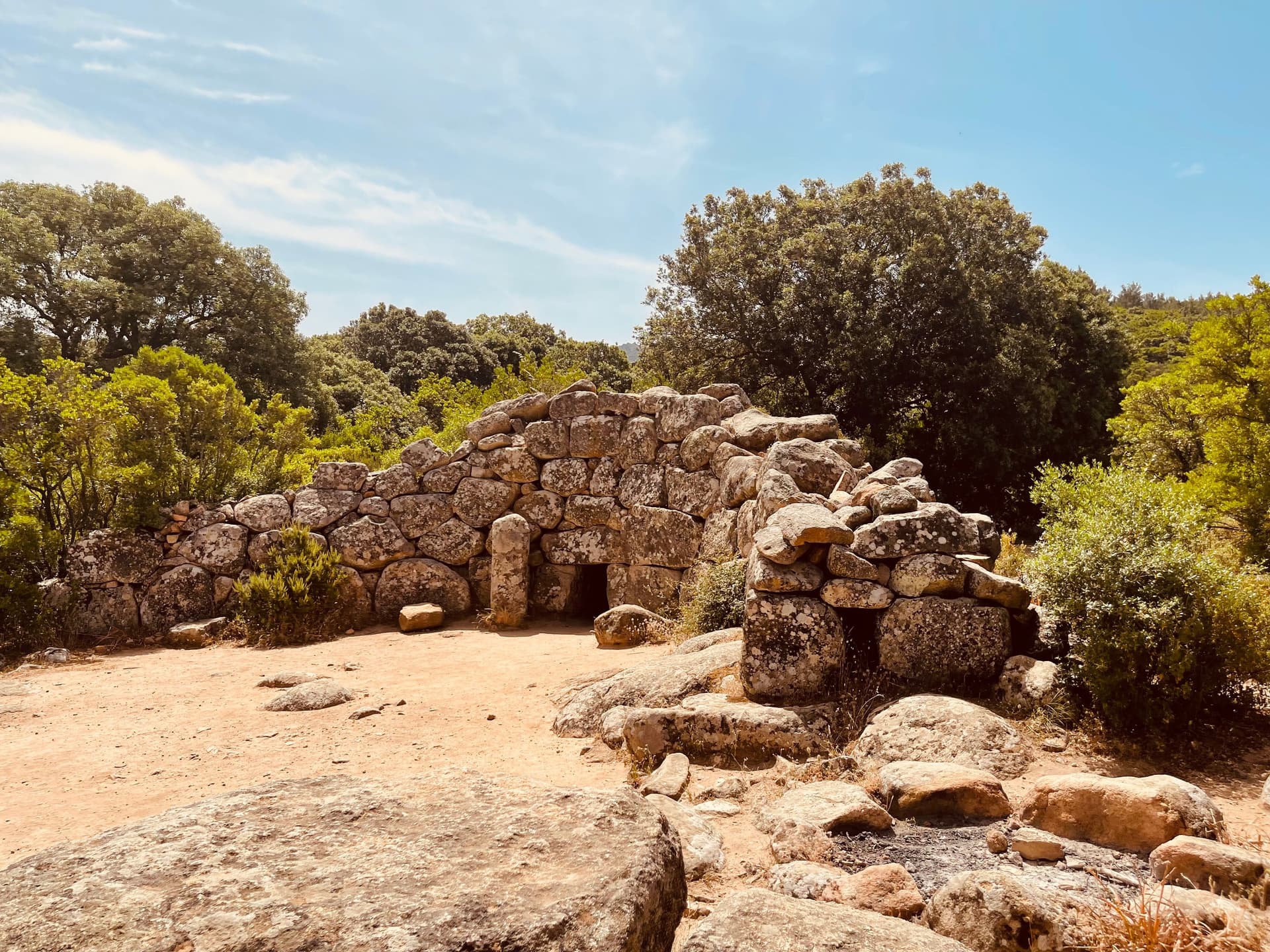
Neolithic tombs carved into rock, the Domus de Janas dot all of Sardaigne. Over 2,500 hypogea dating from 3400 to 2700 BC, some adorned with carved reliefs and red pigments.
The Domus de Janas — literally "houses of the fairies" in Sardinian — are prehistoric tombs carved directly into rock, scattered throughout Sardaigne. Carved between the Late Neolithic and Copper Age (approximately 3400–2700 BC), they represent one of the most singular funerary expressions of the western Mediterranean. Some sites contain just a few isolated chambers; others form veritable necropolises with dozens of cells.
What You'll See
Each tomb is carved directly into limestone or basaltic rock. The entrance, often low, opens onto one or more interconnected chambers with smooth walls. Some preserve carved reliefs—cattle horns, spiral motifs, false pilasters—that evoke symbolic domestic architecture intended for the deceased. Red pigments based on ochre, still visible at a few sites, reinforce the ritual character of these spaces.
History and Context
These hypogea are attributed to Sardinian Neolithic cultures, notably the Ozieri culture. Their popular name reflects local medieval beliefs: inhabitants attributed these mysterious cavities to fairylike creatures. Archaeologically, they served as collective burials, sometimes reused in the Bronze Age. Over 2,500 are recorded across the island, making them one of Europe's densest prehistoric funerary corpora.
Highlights of Your Visit
Anghelu Ruju Necropolis (near Alghero)
One of the island's best-preserved complexes, with about thirty tombs. Several chambers display reliefs of bovine horns and traces of red pigment. The site is managed and open to the public.
Montessu Necropolis (Villaperuccio)
Carved into a cliff of pink trachyte, this necropolis groups over a hundred tombs. The natural amphitheater of the rock and the density of hypogea make it one of the most visually impressive sites.
Domus de Janas of Sant'Andrea Priu (Bonorva)
This complex contains about twenty chambers, including a large central hall converted into a Paleochristian church. The Byzantine frescoes that remain on some walls testify to religious reuse in the first millennium.
Photography Tips
Natural light rarely penetrates deep into the chambers: a headlamp or supplementary lighting significantly improves interior shots. Outdoors, the raking light of early morning or late afternoon brings out the sculpted reliefs on the rock facades. Check restrictions specific to each site—some prohibit flash photography to preserve pigments.
Location and Access
The Domus de Janas are not a single site but a monument type present in nearly every Sardinian province. The most accessible necropolises are found near Alghero (Anghelu Ruju), Sassari, Cagliari, and in the Sulcis region. Most major sites are signposted from main roads. A personal vehicle remains the most practical way to reach them, as public transport rarely serves the immediate surroundings.
Sites managed by cooperatives or municipalities sometimes offer guided tours in Italian and English—inquire at the local tourist office or with your Nomadays agency.
Quick Practical Info
- Access: varies by site—some are free, others charge admission with ticketing on-site
- Dress: closed-toe shoes recommended (rocky and uneven terrain)
- Suggested duration: 30 minutes to 1.5 hours depending on necropolis size
- Accessibility: limited at most sites (natural terrain without amenities)
- Note: some sites close midday in summer—check locally before visiting
Nearby
- Nuraghe Palmavera — a Nuragic tower from the 2nd millennium BC, a few kilometers from Anghelu Ruju near Alghero.
- Alghero Old Town — historic center with Catalan influences, a convenient starting point for exploring prehistoric sites in the northwest.
- Montessu Necropolis — large complex of Domus de Janas in the Sulcis, to visit in combination with sites in the Cagliari region.
- Su Nuraxi of Barumini — UNESCO-listed Nuragic complex, illustrating the civilization that succeeded the Domus de Janas builders.
Interested in this visit?
We can include it in your personalised itinerary.