Gorropu Gorge
Gorropu Gorge
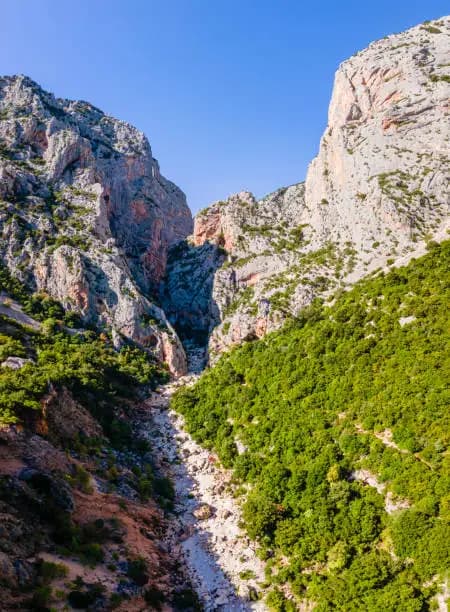
Gorropu Gorge, in Sardinia's Supramonte, is one of Europe's deepest canyons. Vertical walls, rocky floor and the rio Flumineddu: a demanding hike into the heart of Barbagia.
Gorropu Gorge opens between the limestone massifs of the Supramonte, on the border between the communes of Urzulei and Orgosolo. Its vertical walls reach heights of over 400 metres in places, making this canyon one of the deepest in Europe. The floor, cluttered with rock blocks and crossed by the rio Flumineddu, remains in shadow for much of the day. A visit demands good physical condition and appropriate equipment.
Practical information at a glance
- Access: departure from Su Gorroppu Lodge (former shepherd's hut on the SS125 road), or from Dorgali via the rio Flumineddu — two distinct approaches.
- Recommended duration: allow a minimum half-day from the nearest starting point; a full day from Dorgali.
- Difficulty: physical hike over rocky and unstable terrain; trekking shoes mandatory.
- Equipment: plenty of water, sun protection, walking poles recommended.
- Accessibility: not wheelchair accessible.
- Season: avoid peak summer heat; spring and autumn are the best seasons.
What to see
The Supramonte's limestone walls dominate the canyon along its entire length. The floor is scattered with collapsed blocks, some several metres in diameter, which the rio Flumineddu circles or covers depending on the season. Vegetation is limited to a few wild fig trees and tufts of grass clinging to crevices. Direct sunlight only touches the floor at certain times, creating a striking contrast between shadow and white rock.
History and context
The Supramonte has been inhabited since prehistory: nuraghi and giant tombs dot the surrounding plateaus. The gorge itself served as a natural refuge and passage for transhumant shepherds. The canyon remained known only to inhabitants of Barbagia and Ogliastra until it was mapped and frequented by speleologists and hikers from the 1980s-1990s onwards.
Highlights of the visit
The canyon entrance
The first metres into the gorge immediately convey the scale of the place. The walls close in and the light changes. This is where most visitors stop to photograph the enclosure.
Progression over the blocks
Moving forward along the canyon floor demands attention: the limestone blocks are slippery in places. This slow, almost technical progression is an experience in itself.
The rio Flumineddu
Outside of summer, the watercourse is present and audible. In spring, it can be impassable at certain passages. Check conditions before setting out.
Photography tips
Direct light in the canyon floor is rare and brief. At midday, the white walls overexpose easily. Favour times when low-angle light touches the top of the cliffs — early morning from the western entrance. A wide-angle lens is useful for conveying the height of the walls. Photos taken looking upwards towards the sky between the two walls are characteristic of the place.
Location and access
The gorge is located in the Supramonte, between Urzulei and Orgosolo, in central-eastern Sardinia. The most common access starts from Su Gorroppu Lodge, accessible from the SS125 (Strada Orientale Sarda). From Dorgali, a longer approach follows the rio Flumineddu upstream. No public transport serves the starting point: a personal vehicle or an organised transfer is essential. Local guides offer accompaniment departing from Dorgali and Orosei.
Nearby
- Dorgali — departure town for numerous excursions into the Supramonte, with local crafts and wine cellars.
- Nuragic Village of Tiscali — archaeological site hidden in a Supramonte sinkhole, accessible on foot from the Lanaittu valley.
- Cala Gonone — seaside resort on the Gulf of Orosei, access point to wild coves along the coast.
- Bue Marino Cave — sea cave accessible by boat from Cala Gonone, with stalactite formations.
Frequently asked questions
Spring (April-June) and autumn (September-October) offer pleasant temperatures and moderate water flow in the rio Flumineddu. In summer, the heat in the canyon floor can be intense and water scarce.
A guide is not required for the standard approach from Su Gorroppu Lodge. It is strongly recommended for the longer approach from Dorgali or for venturing deep into the canyon, where orientation can be difficult.
Hiking shoes with aggressive soles, plenty of water, sun protection, walking poles. Avoid sandals or light sports shoes: the rocky terrain is uneven and sometimes slippery.
Yes. The nuragic village of Tiscali and the Lanaittu valley are accessible in the same area. Plan two separate days: each site already requires a half-day to a full day.
No known photography restrictions. The canyon is a public natural site. Drones may be subject to local regulations on protected natural areas — check before departure.
No regular public transport serves Su Gorroppu Lodge. Local agencies in Dorgali and Cala Gonone offer transfers and organised excursions including transport from the coast.
Interested in this visit?
We can include it in your personalised itinerary.