Cagliari and the South
From Cagliari to the dunes of Chia, from the Porto Flavia mines to the Phoenician site of Nora: a southern Sardaigne where city, beaches and industrial heritage converge.
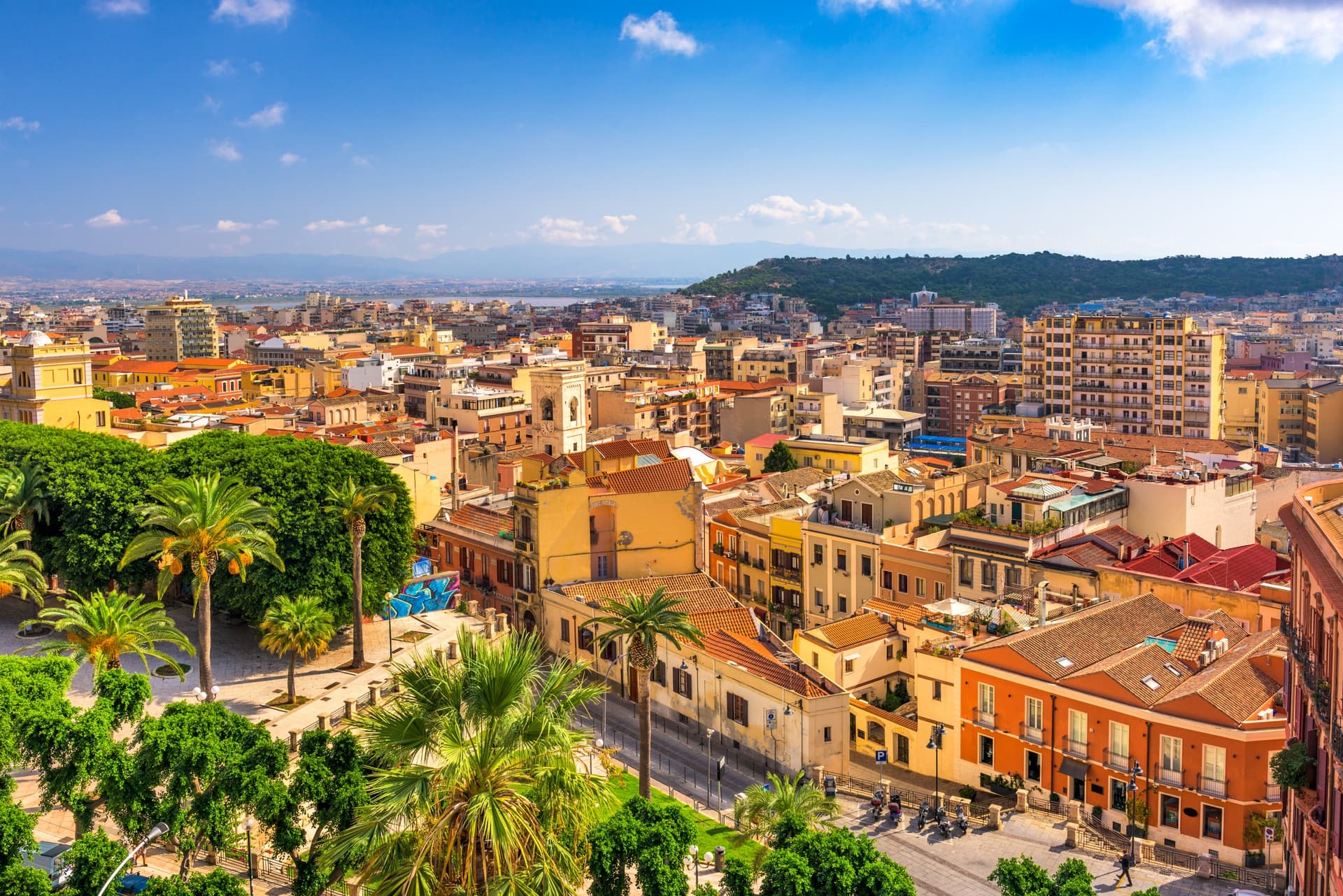
Cagliari serves as our base: this is where our agency is located, just a few streets from the port and the historic Castello district. The city rises on seven limestone hills overlooking the Gulf of Angels, which stretches for 13 kilometers. You climb to Castello through cobbled alleyways to reach the cathedral of Santa Maria and the bastions of Saint-Remy, from where you can take in the ochre rooftops, the salt marshes and, on clear days, the silhouette of the Sella del Diavolo closing off the gulf to the southeast. Below, the neighborhoods of Marina, Stampace and Villanova line up with trattorias where you can taste fregola with clams, spaghetti with sea urchins in winter, and roasted porceddu on a spit.
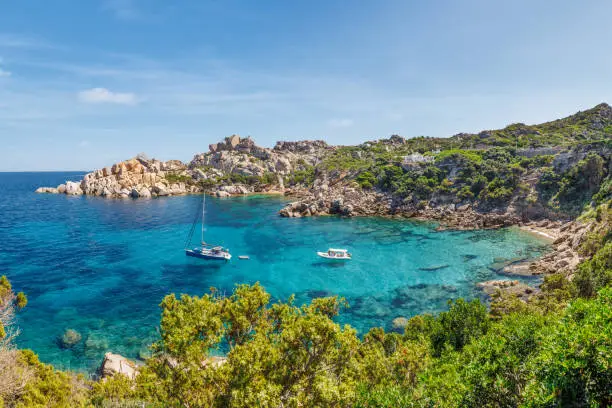
Southern Sardaigne reads in three parallel bands. The southeastern coast, from Villasimius to Cape Carbonara, chains together granite coves and beaches of very white sand like Punta Molentis or Porto Giunco. The southwestern coast, from Chia to Porto Pino, unfolds dunes 30 meters high, brackish lagoons and 16th-century Spanish towers that punctuated the defense against Barbary raids. Between the two, the interior of the Sulcis and Iglesiente forms a country of hills wooded with holm oaks, crossed by old mining roads.
This industrial history remains visible. Carbonia was founded from scratch in 1938 to exploit coal, with its grid plan and rationalist architecture. Iglesias, older, retains the headframes and galleries of Monteponi and Porto Flavia, the latter carved into a cliff above the sea to load ore carriers directly. At Nebida and Masua, the ruins of washing plants overlook turquoise waters and the Pan di Zucchero, a limestone rock 132 meters tall that emerges 50 meters from shore.
Cagliari itself is a city of water. The Molentargius and Santa Gilla lagoons, which produced salt until the 1980s, now host a sedentary colony of pink flamingos, about 10,000 individuals during nesting season. You can observe them on foot from the park, twenty minutes from downtown. The urban beach of Poetto, 8 kilometers of fine sand, extends the city eastward: Cagliari residents head down there after work from April to October.
The local calendar deserves attention. The feast of Sant'Efisio, on May 1st, has mobilized since 1657 more than 3,000 figures in traditional costumes from all the villages of the island, who escort the saint in procession from Cagliari to Nora, over 65 kilometers. It is an opportunity to see the costumes of Campidano, Barbagia and Sulcis gathered together, which are then worn at the summer patron saint festivals. The archaeological site of Nora, founded by the Phoenicians in the 9th century BC and later occupied by Carthaginians and Romans, preserves a theater with its feet in the water and mosaics from thermal baths.
The region lends itself to slow travel. Distances seem short on the map, but the coastal roads of the Sulcis wind, and you easily lose an hour between one cove and the next. Our advice: choose two bases, one in Cagliari for urban culture and the southeastern coast, another on the side of Chia or Sant'Antioco for the western facade and the mines.
To discover
Castello and the old town of Cagliari. Half a day to climb to the bastions, visit the cathedral and the national archaeological museum, then head back down to lunch at Marina around fregola with seafood.
Beaches of Chia and Tuerredda. Fifteen kilometers of dunes, flamingo lagoons and shallow waters south of Pula. Tuerredda, sheltered between two granite promontories, can be crossed on foot in winter to the islet facing the beach.
Porto Flavia and Masua mines. Guided tour of a gallery carved in 1924 into the cliff to load ore carriers. The exit opens onto the Pan di Zucchero, 50 meters from shore.
Phoenician and Roman site of Nora. Theater, thermal baths and mosaics on a windswept peninsula, 35 kilometers from Cagliari. The site can be combined with the Su Guventeddu beach and the Coltellazzo tower.
Pink flamingos of Molentargius. Urban reserve of 1,600 hectares twenty minutes from downtown, where approximately 10,000 flamingos nest. Observation on foot or by bike, ideal in late afternoon.
When to go
The best window for combining culture and beaches extends from mid-May to end of June, then from early September to mid-October. Temperatures in Cagliari then range between 22 and 28°C, the sea exceeds 21°C from mid-June onwards, and archaeological sites remain accessible without suffering from the heat. July and August regularly reach 34-36°C, sometimes 40°C when the sirocco blows from North Africa, and the beaches of Chia or Tuerredda saturate from 10am. For travelers who prioritize hiking in the Sulcis or visiting the mines, March to May and October to November offer days at 18-22°C, ideal for walking.
In winter, from December to February, it remains mild on the coast, around 14°C during the day, but rains concentrate on October-November with 70 to 90 mm per month. The city remains lively, many establishments open, and it is the season when Cagliari is experienced as a real Mediterranean capital rather than as a beach destination.
Practical advice
We recommend a minimum of 4 full days for this region: one day in Cagliari, one day on the southeastern coast to Villasimius, one day at Chia and Nora, one day in the mining Sulcis or on the islands of Sant'Antioco and San Pietro. Five to six days allow you to include the crossing to Carloforte, a former Ligurian colony populated in the 18th century, where a Genoese dialect is still spoken and where red tuna is cooked according to North African recipes. Cagliari-Elmas airport, 10 minutes from downtown, serves most major European cities and is our logical entry point.
The most fluid combination is made with Barbagia and Supramonte, 2 hours 30 minutes drive to the north, to transition from the coast to mountain villages. A 12 to 14-day loop can chain together Cagliari, Barbagia, the Gulf of Orosei then climb up to Gallura. The south suits travelers as couples or families, history enthusiasts (nuragic prehistory, Phoenicians, mines), and those who want to balance cultural visits and swimming without driving more than 90 minutes a day. The comfort level is high: renovated farmhouses, boutique hotels in Cagliari, guesthouses in rehabilitated former mining villages.