Gallura and the North
The northeast tip of Sardaigne, Gallura blends pink granite sculpted by the mistral, the La Maddalena archipelago and stone villages of Monte Limbara.
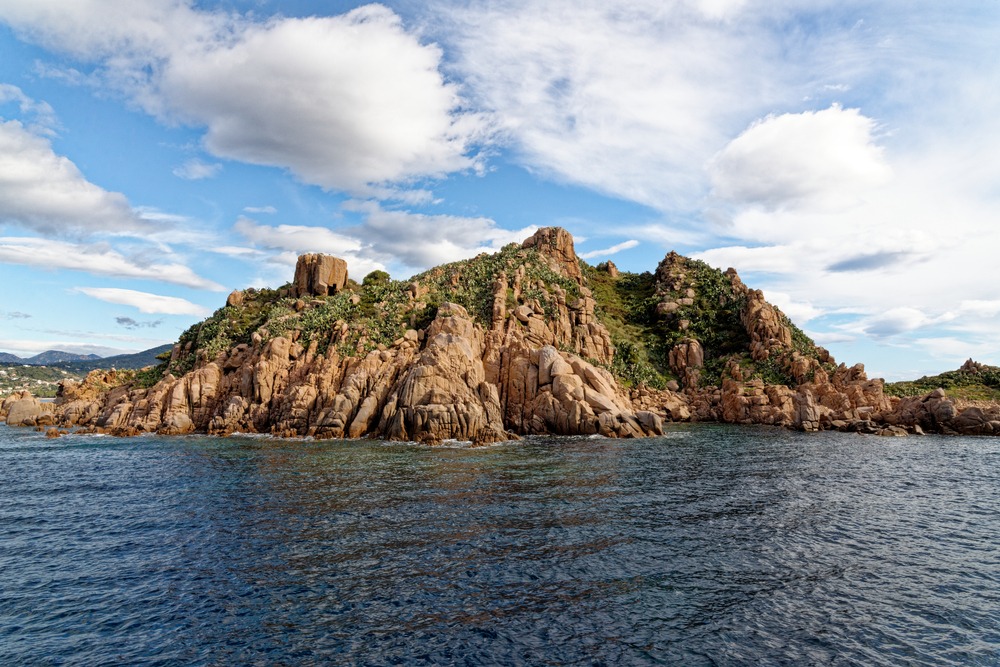
Gallura occupies the northeast tip of Sardaigne, between Olbia and the Strait of Bonifacio, which separates it from Corsica by just 11 kilometers. Our team works there year-round, and we love reminding travelers that this region, often reduced to Costa Smeralda, possesses singular geology: a foundation of pink and grey granite dating back 300 million years, eroded by the mistral into rounded forms, rocky chaos, and low cliffs. At Capo Testa, near Santa Teresa Gallura, these sculpted blocks form a peninsula connected to the mainland by a sand isthmus. Valle della Luna, just nearby, once sheltered a hippie community nestled in the granite's crevices.
The coastline is carved into narrow creeks, the cale, separated by maquis headlands. Between Palau and Olbia, over some thirty kilometers, Porto Cervo, Liscia di Vacca, Romazzino, and Cala di Volpe succeed one another, the nuclei of Costa Smeralda developed by the Aga Khan from 1962 onward. The architectural specifications still impose low rooflines and ochre renderings today. Away from this perimeter, the beaches of Rena Bianca, La Marinedda, and Spiaggia del Principe retain a rawer character, with modest parking and seasonal refreshment stands.
Off the coast of Palau, the La Maddalena archipelago brings together seven main islands and some fifty islets, designated a national park since 1994. The ferry to La Maddalena departs every 30 minutes in high season and takes 20 minutes. From there, a bridge leads to Caprera, where Garibaldi spent his final years in the Casa Bianca, now a museum. Spargi, Budelli, and Razzoli are only visited by boat, with regulated anchorages and a pink beach, Budelli's Spiaggia Rosa, off-limits to foot traffic since 1994 to preserve its coralline sand.
Interior Gallura is a land of granite and cork oak. Cork harvesting, every nine years, still sustains parts of Calangianus and Tempio Pausania. Tempio, perched at 566 meters above sea level at the foot of Monte Limbara (1,359 m), offers temperatures 5 to 8 degrees lower than coastal areas in summer. Its historic center is built in grey granite blocks, like neighboring Aggius, known for its male polyphonic songs, the tasja, inscribed in Gallurese oral tradition. Gallurese, spoken here, is closer to South Corsican than to Sardinian Logudorese.
On the table, Gallurese cuisine is distinguished by zuppa gallurese, a gratin of stale bread, mutton broth and cheese, and chiusoni, elongated gnocchi served with tomato sauce and sausage. Vermentino di Gallura, Sardaigne's only DOCG since 1996, is enjoyed young and chilled with seafood. The wineries of Monti, Berchidda, and Luras welcome visits by appointment. In late August, the Time in Jazz festival in Berchidda, founded by trumpeter Paolo Fresu, moves concerts into country churches and beneath the cork oaks of the surroundings.
Olbia, with 60,000 inhabitants, is the main entry point to the region with its Costa Smeralda airport and ferry port to Genoa, Livorno, and Civitavecchia. The city itself goes quickly: the 11th-century Romanesque basilica of San Simplicio, an archaeological museum devoted to Roman shipwrecks, and the pedestrian Corso Umberto. It serves mainly as a logistical base from which to explore north and east.
To Discover
La Maddalena Archipelago by boat. Day trip by gozzo between Spargi, Budelli, and Santa Maria, shallow waters above sandy bottoms, anchorages at Cala Corsara and Cala Soraya. Departures from Palau or Cannigione.
Capo Testa and Valle della Luna. Two-hour walk amid granite blocks sculpted by wind, at the northern tip facing Bonifacio. Late afternoon light on the rock, swimming in Cala di l'Ea.
Tempio Pausania and Monte Limbara. Centre in grey granite at 566 m elevation, thermal springs at Rinaggiu, then scenic road to the Limbara antennas at 1,359 m, views over both coasts of the island.
Polyphonic songs of Aggius. Village of 1,500 residents renowned for tasja, four-voice male polyphony. The MEOC museum traces the tradition of banditry and local weaving.
Vermentino DOCG between Monti and Luras. Visits to family wineries, tastings of Sardaigne's only wine classified DOCG since 1996. At Luras, prehistoric dolmens and thousand-year-old olive trees at S'Ozzastru, dated to over 3,000 years old.
When to Go
The best window runs from mid-May to late June, then early September to mid-October. Sea temperatures reach 22 to 24 degrees in June and remain swimmable through late October. Air hovers between 22 and 28 degrees daytime at these periods, with a mistral that can blow at 40 or 50 km/h, especially in spring: useful for sailing and windsurfing, more constraining for small boat outings to La Maddalena, sometimes cancelled.
July and August concentrate Italian visitors and the highest prices, with coastal temperatures of 30 to 33 degrees and beaches saturated between 11am and 5pm. The week of August 15 (Ferragosto) is best avoided if seeking calm. In the interior, around Tempio and Limbara, the air remains 5 to 8 degrees cooler, making it a coherent summer retreat. November through March are mild (12 to 16 degrees daytime) but many beach facilities close, and connections to the archipelago's minor islands become less frequent.
Practical Advice
We recommend 4 to 5 full days for Gallura, without rushing: one day by boat in the La Maddalena archipelago, one day along the north coast between Santa Teresa and Capo Testa, one day inland (Tempio, Aggius, Luras), and one to two days of beaches of your choice between Rena Majore, Rena di Matteu, and the Costa Smeralda coast. The logical entry point is Olbia airport, 30 minutes from Palau and 1 hour from Santa Teresa. Olbia is also connected by ferry to Genoa (10 hours), Livorno (8 hours), and Civitavecchia (5 to 7 hours), convenient if traveling with your vehicle.
The region pairs well with the Gulf of Orosei just to the south (2 hours by road from Olbia), for those wanting to experience two types of coastline, granite in the north and limestone in the south. A broader loop can combine Gallura with Barbagia and Supramonte for a sea-mountain contrast, some 10 to 12 days total. The comfort level in Gallura is high: boutique hotels, stone farmstays, a few five-star properties on Costa Smeralda. The region suits couples, families with children from age 6 onward (boat outings are lengthy), and sailing or diving enthusiasts. Pure hikers will find more substance in the Supramonte.